

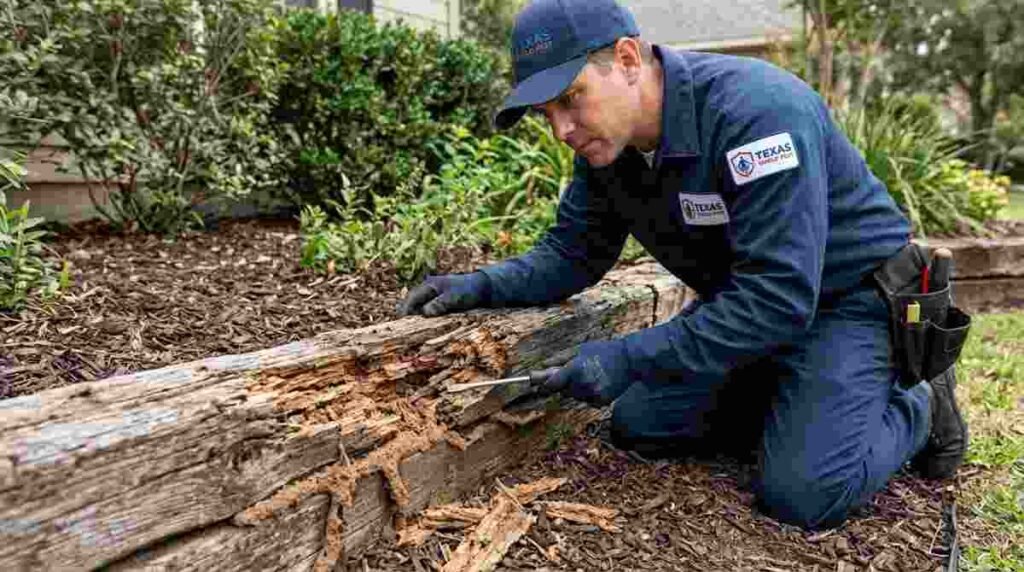
Termites in railroad ties are a real risk, because old ties and landscape timbers sit in damp soil and slowly lose the treatment that once protected them. For Huntsville properties with raised beds, retaining walls, or rural acreage, knowing which timbers invite termites helps keep them away from the house.
Do Railroad Ties Attract Termites?
Railroad ties do attract termites once their wood preservative weakens with age and weather. New ties are treated to resist decay, but years of ground contact, sun, and rain leave the wood softer and more appealing.
Landscape timbers bring the same problem on a smaller scale. Many are thinner and less heavily treated, and they rest directly on soil where subterranean termites already forage.
Both materials also hold moisture against the ground. That damp wood-to-ground contact is exactly what termites look for.
How Used Railroad Ties Have Spread Formosan Termites in Texas
Used railroad ties have helped carry Formosan termites to new parts of Texas. According to Texas A&M Urban Entomology, recycled railroad ties are thought to be the main way Formosan termites spread in the state.
Texas A&M also reports that Formosan termites were first found in Texas in 1956 near the Houston Ship Channel. Since then, they’ve been detected in 31 Texas counties and the list keeps growing, while infestations have been reported in all the major metropolitan areas.
The risk comes from moving infested wood, not from ties themselves. A colony inside a tie can ride a truck a long way and start over in a new yard, while Walker County remains unconfirmed for Formosan termites.
Signs Your Landscape Timbers Have Termites
Walk your timbers and check for these signs:
- Soft or crumbling wood, especially at the soil line
- Mud tubes on the sides of ties or on nearby walls
- A hollow sound when you tap the timber with a tool handle
- Live termites under a pried-up corner or loose piece
- Swarmers or shed wings near beds in spring
- Gaps or sagging in walls where wood has broken down
Probing with a screwdriver shows soft spots fast. If the tip sinks in easily, the timber has likely lost strength and may be feeding termites.
Railroad Ties vs. Other Landscape Materials
Each material carries a different termite risk, and non-wood options remove the food source entirely.
| Material | Termite Risk | Ground-Contact Durability | Notes |
| Used railroad ties | High once preservative weakens; may carry termites from elsewhere | Varies with age and history | Source and condition often unknown |
| Treated landscape timbers | Moderate, and rises as treatment fades | Usually shorter than heavy ties | Check that they’re rated for ground contact |
| Stone, brick, or concrete block | Very low, with no food value | Long-lasting | Termites may still travel through gaps |
| Composite or recycled plastic timbers | Very low | Long-lasting | Confirm the product suits soil contact |
Material choice doesn’t replace inspection, but it changes the odds. If termites turn up in old ties, our Formosan termite control service is able to identify the species before you decide on next steps.
Replacing or Protecting Termite-Damaged Timbers
Replacing damaged timbers works best when you remove the risk and choose materials that hold up in soil.
Removing Ties Near the Foundation
Start with ties and timbers closest to the house, since they give termites the shortest path to framing. Pull them out completely, including buried sections and stakes.
Inspect the soil and nearby wall as you remove each piece. If you find live termites, stop and have the area checked before disturbing more.
Choosing Ground-Contact Replacement Materials
Pick materials made for ground contact, such as stone, concrete block, or composite timbers. If you prefer wood, choose new lumber rated for ground contact and keep it off the foundation line.
Avoid used ties with an unknown history. Their condition, past treatment, and possible hitchhiking insects are hard to judge in the yard.
When to Call a Termite Professional
Bring in a professional if you find live termites, tubes on nearby walls, or damage in timbers that touch the foundation. An inspector will name the species and check whether the colony reached the house.
Texas Shield Pest can look at the yard and the home in one visit, with annual termite inspections afterward to track any new activity. If ties sit against your house, schedule a free inspection before you start pulling them out.
Huntsville, TX Properties: Raised Beds, Retaining Walls, and Rural Acreage
Huntsville properties use railroad ties and timbers in raised garden beds, terraced slopes, driveway borders, and retaining walls. Each one puts wood in steady contact with damp soil.
Rural acreage adds fence posts, barns, and old tie piles that may sit untouched for years. Lake neighborhoods such as Elkins Lake also use timbers to hold back soil on sloped lots near the water.
Piney Woods moisture keeps soil damp under timbers much of the year. As a result, older landscape wood here can break down sooner than owners expect.
Railroad Tie Termite FAQs
How far from the house should landscape timbers be?
There’s no single distance that fits every yard. Keep timbers clear of the foundation, and ask an inspector to judge your specific layout, grading, and moisture.
Can termites in a retaining wall reach the foundation?
Yes, if the wall connects to soil that runs toward the house. Termites can travel through that soil, so a wall near the foundation deserves regular inspection.
Is it worth buying used railroad ties for landscaping?
Usually not. Texas A&M Urban Entomology links recycled ties to Formosan spread in Texas, and their condition is hard to judge. Stone, concrete, or new ground-contact materials are simpler choices.
Protect Your Huntsville Property From Timber Termites
Termites in railroad ties can turn a garden bed into a feeding ground, but replacing old wood removes the risk at its source. Keep timbers away from the foundation, choose ground-contact materials, and check beds each spring.
Have a licensed inspector walk your Huntsville property and point out which timbers should go first. Let Texas Shield Pest check your timbers, beds, and foundation in one free visit before old ties become a bigger problem.