

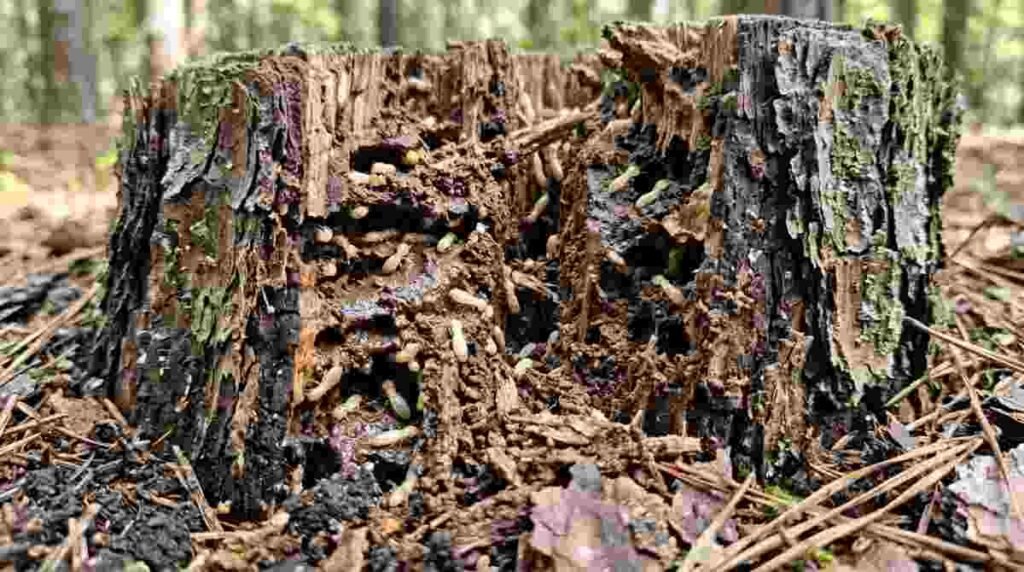
Termites in pine stumps are a frequent sight in Piney Woods yards, because a dead stump and its roots give a colony food and moisture right in the soil. For Huntsville homeowners, the real question is whether that colony stays in the yard or heads for the house.
Why Pine Stumps Attract Termites
Pine stumps attract termites because the wood is dead, damp, and tied into the soil through a large root system. Native subterranean colonies live underground, so a stump gives them food they can reach without leaving the ground.
As the stump decays, fungi soften the wood, which makes feeding easier. Roots also spread underground in many directions, so a colony can expand along them for years.
Freshly cut pines matter too. Lots cleared for building often leave stumps that start breaking down right when a new house goes up beside them.
Signs a Stump Has Termites
Check stumps for these signs, especially in spring:
- Soft, crumbly wood that breaks apart in your hand
- Mud-lined galleries or dirt packed into cracks
- Pale, soft-bodied worker termites when you pull back bark
- Winged swarmers or discarded wings near the stump
- Mud tubes crossing the stump surface or nearby wood
- Hollowed areas inside the wood with no sawdust
Carpenter ants also nest in stumps, but they push out coarse sawdust and don’t line their tunnels with mud. So mud and soil inside the wood point to termites.
Native Subterranean vs. Formosan Termites in Stumps
Most stump infestations around the area will be native subterranean termites, but Formosan termites are worth knowing about as a type to identify.
| Feature | Native Subterranean Termites | Formosan Termites |
| Nesting | In the soil, connected to moisture | In soil, and can build carton nests above ground |
| Food range | Dead wood and other cellulose | A wider range of cellulose, including living plants |
| Walker County status | Found throughout the area | Not confirmed in Walker County |
| Identification | Needs a professional sample | Needs a professional sample |
According to Texas A&M Urban Entomology, Formosan termites have turned up in 31 Texas counties so far, but they have not been confirmed in Walker County. Texas A&M AgriLife Extension notes they build carton nests that let them survive above ground, and the Texas Invasive Species Institute reports they attack more than 50 species of living plants. For those reasons, a professional should identify any colony found in a stump.
Can Termites Move From a Stump to Your House?
Yes, termites can move from a stump to your house when roots, soil, or wood connect the two. Workers forage outward through the soil, so a stump near the foundation can feed a colony that later finds sill plates or framing.
Distance helps but doesn’t settle the question. Roots can run far from the stump, and moist soil along a slab or crawl space offers the same conditions termites found in the yard.
A stump close to the house deserves more attention than one at the back of the lot. Still, both should be checked if you see activity.
What to Do About a Termite-Infested Stump
Dealing with an infested stump usually means removing the food source and checking the soil around it.
Stump Grinding and Root Removal
Grinding takes the stump below grade and removes much of the wood termites feed on. Ask the crew to grind deep and pull large roots where possible, because roots left behind can keep feeding a colony.
Clean up the grindings afterward. A mound of chips where the stump stood gives termites a fresh, damp food pile.
Treating the Soil Around the Stump
Soil treatment near a home belongs with a licensed applicator, not a weekend project. A professional decides whether treatment is needed, which EPA-registered product fits, and how close to the foundation it should go.
Homeowners should skip store-bought chemicals around stumps. Misapplied products can miss the colony and contaminate soil or water without solving anything.
When to Call a Termite Professional
Call a professional when you see live termites in a stump within sight of the house, or when tubes or swarmers appear near the foundation. An inspector can check both the stump and the home, then identify the species.
If identification ever points to Formosan termites, our Formosan termite control service can explain the next steps. For a stump near your foundation, a free inspection now can show whether roots are leading termites closer.
Huntsville, TX Yards in the Piney Woods: Local Stump Risks
Huntsville sits in the East Texas Piney Woods beside Sam Houston National Forest, so pine stumps show up in yards, vacant lots, and new subdivisions alike. Many homes back onto wooded land where fallen trees and old stumps are part of the landscape.
Newer developments like Texas Grand Ranch frequently clear pines for homesites and driveways. Stumps left near foundations or under landscaping can sit for years while termites feed below the surface.
Storms and age also bring down trees in established yards. A pine that falls or gets removed leaves roots underground long after the trunk is gone.
Pine Stump Termite FAQs
Should I burn a termite-infested stump?
Burning rarely helps, because it seldom reaches the roots where colonies live. Local burn rules and burn bans also apply, so check them before considering it.
Can mulch from ground stumps spread termites?
Fresh grindings can feed termites already in the soil. Spread grindings well away from the house, and don’t pile thick mulch against the slab or siding.
How long do termites stay after a stump is removed?
It varies. Colonies can keep feeding on roots left underground, so activity may continue until that wood is gone. An inspection shows whether termites moved toward the house.
Get Your Yard and Home Checked for Termites
Termites in pine stumps don’t have to mean trouble for your home, but they deserve a look whenever activity shows up nearby. Removing stumps and roots, and keeping lumber and logs clear of the slab, lowers the odds.
A expert termite inspection in Huntsville will confirm whether a yard colony has reached the house, and scheduling a free one gives you a clear answer either way.